Will AI replace construction estimators?
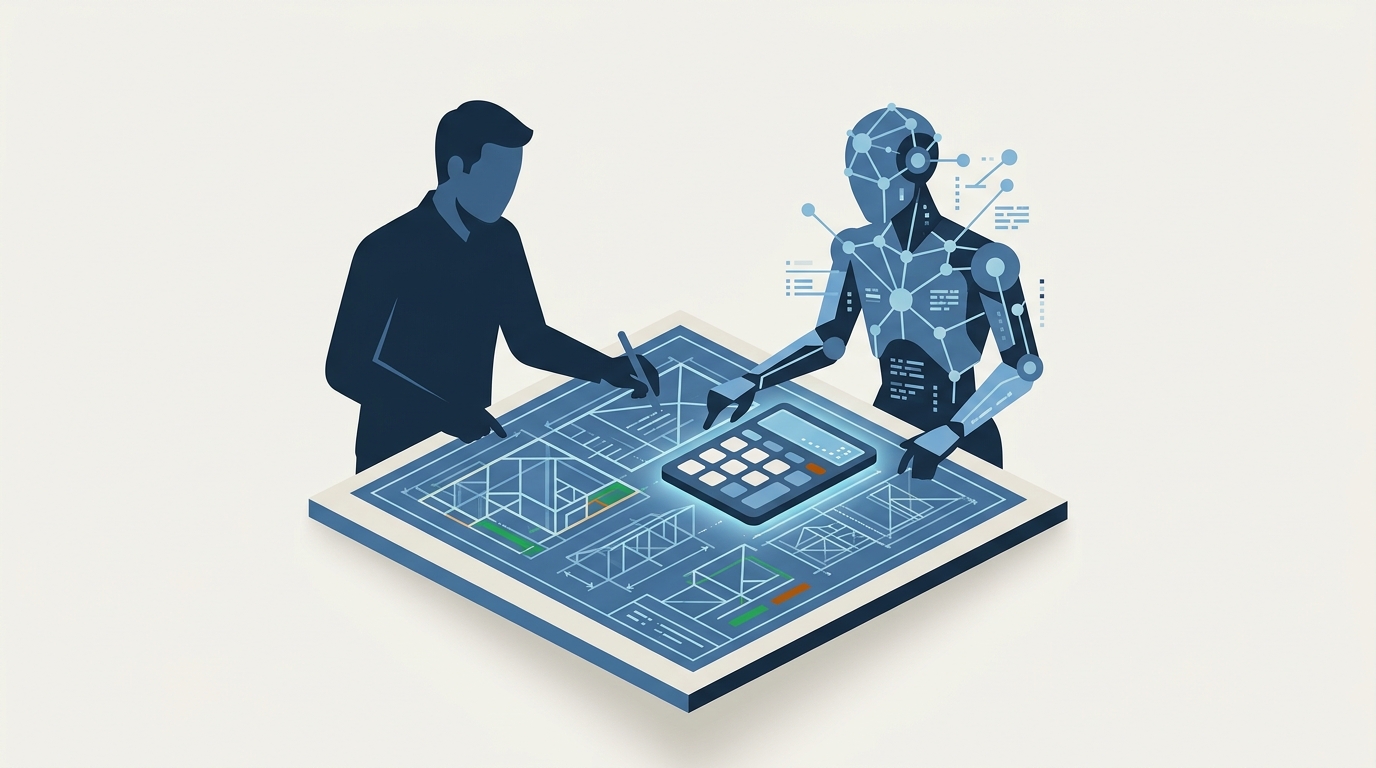
No — AI won't replace construction estimators. It changes the job rather than eliminating it. AI is very good at the grind: reading plans, building the takeoff, and pricing lines fast and consistently. But someone still has to review those numbers, apply judgment, make the market calls, and put their name on the bid. The estimator's role shifts from data entry to decisions — which is a better job, not a missing one.
What is AI actually good at?
The parts of estimating that are slow, repetitive, and easy to get wrong are exactly the parts AI handles well:
- Takeoff — reading a plan set and pulling square footage, foundation, finish level, and systems out of the drawings in minutes instead of an afternoon.
- Line-by-line pricing — attaching a cost to every category without skipping the boring ones like general conditions and cleanup.
- Consistency and speed — it doesn't get tired, doesn't cut corners under deadline, and lets you quote more jobs. The first solid quote often wins the work.
If your day is mostly keying numbers into a spreadsheet and hoping the formulas didn't break, AI takes that off your plate. That's the grind, and it should go.
What still needs human judgment?
Everything that makes an estimate a decision rather than a calculation:
- Unusual scopes — an odd site, a tricky remodel, a design with no precedent in your history. AI can flag it; it can't feel the risk.
- First-of-a-kind items — a new material or a feature you've never built has no comparable to price from. That needs a real sub quote or a phone call.
- The market call — whether to sharpen your pencil on a job you want or hold firm. That's a business judgment about your shop, your pipeline, and your margin.
- Owning the number — when the client asks why a line is what it is, a person answers. AI doesn't sign the contract or stand behind the bid.
AI does the takeoff and the math. The estimator makes the call and owns the number. That division isn't going away.
Why do your own historical numbers matter so much?
This is the reason the human doesn't disappear. An estimate is only as trustworthy as the data behind it — and generic AI trained on national averages gives you an average for a house that doesn't exist. It doesn't know your crews, your suppliers, or your market.
- Your history is the ground truth. Numbers pulled from your own completed jobs already reflect what things actually cost you — no guessing, no padding.
- Oversight catches what automation can't. A good tool flags any line it can't ground and asks for a real number instead of quietly inflating it. That flag is only useful if a human is there to answer it.
- You're the one accountable. The owner or estimator who reviews and adjusts the AI's draft is the person whose margin is on the line. That accountability is exactly why the role stays.
What does the estimator's job look like now?
Less typing, more judging. Instead of building a takeoff from scratch, you're reviewing one that's already priced from your history. You spend your time on the lines that matter — the unusual ones, the risky ones, the ones worth negotiating — and let the software handle the rest. You quote faster, catch more of the money you were leaving on the table, and still own every number in the bid.
Bottom line
Will AI replace construction estimators? No. It automates the grind and elevates the judgment. The estimator who leans on AI to handle takeoff and pricing — while keeping their hands on the review, the market calls, and the number itself — will out-quote the one still doing it all by hand. The job changes shape; it doesn't disappear.
That's exactly how Cubria is built: it does the grind — reads the plans, builds the spec, and prices each line from your own completed jobs — and you review and adjust. When it hits a line it can't ground, it flags it and asks you for a real number instead of guessing. The number stays yours. If you want to see how that stacks up against the alternatives, here's the straight comparison.
Frequently asked questions
Will AI replace construction estimators?
No — it changes the job rather than eliminating it. AI handles the grind of takeoff and pricing, but someone still has to review the numbers, apply judgment, make the market calls, and put their name on the bid.
What parts of estimating can AI actually do?
The slow, repetitive parts: reading a plan set for takeoff, pricing every line without skipping the boring categories, and doing it fast and consistently so you can quote more jobs. If your day is mostly keying numbers into a spreadsheet, AI takes that off your plate.
What does an estimator's job look like with AI?
Less typing, more judging. Instead of building a takeoff from scratch, you review one already priced from your history, spend your time on the unusual and risky lines, and still own every number in the bid.
Bring a past build and see the quote Cubria puts together.