Can AI estimate construction costs?
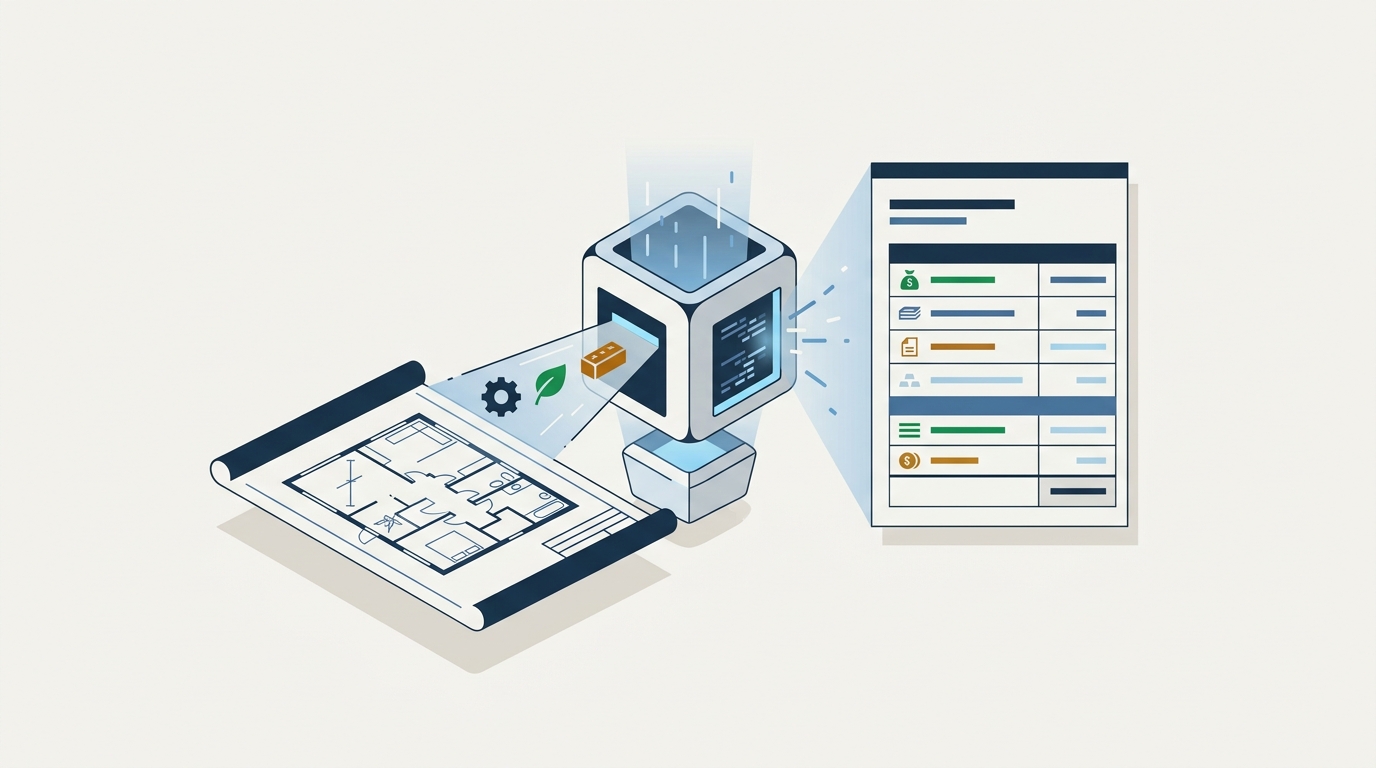
Yes — AI can estimate construction costs, and it's already doing it. It can read a set of plans, pull out the scope, and put a price on nearly every line in a fraction of the time it takes by hand. But there's a catch that matters more than the technology: AI is only as good as the cost data behind it. AI trained on generic national averages gives you generic numbers. AI grounded in your own completed jobs gives you numbers you can actually defend to a client.
How does AI estimating actually work?
Most AI estimating tools follow the same three steps, whatever they call it:
- Reads the plans and documents — it pulls square footage, foundation type, finish level, and the big systems out of the drawings and specs you upload, instead of you keying it in.
- Builds a structured spec — it turns that into a typed, editable list of what the job actually is, so the estimate has something concrete to price against.
- Prices each line — it attaches a cost to every category and line item, then rolls it up into a total.
The first two steps are where AI shines. Reading a plan set and organizing scope is exactly the kind of tedious, error-prone work software should do. The third step — pricing — is where the quality of an estimate is won or lost.
What does AI do well?
AI removes the grind that makes estimating slow and inconsistent:
- Speed — a takeoff that took an afternoon takes minutes, so you can quote more jobs and respond faster. The first solid quote often wins the work.
- Consistency — it won't skip general conditions, temporary services, or cleanup because it was in a hurry. The unglamorous categories are exactly where shops leave money on the table.
- Traceability — good tools show where each number came from, so you're reviewing decisions instead of retyping a spreadsheet.
Where does AI still need a human?
AI is a strong first draft, not a signature on the contract. It needs your judgment on:
- Unusual scopes — an odd site condition, a steep lot, a gut renovation with surprises behind the walls. AI can flag these but can't feel them the way someone who's built there can.
- First-of-a-kind items — a material you've never used or a feature you've never built has no history to price from. That line needs a real sub quote or a phone call, not a computer-generated guess.
- Market judgment — whether to be aggressive on a job you want or hold firm on price is a business call, not a math problem.
The number you can defend is the one that traces back to a job you actually built — not an average of houses that don't exist.
How can you tell a trustworthy AI estimate from a guess?
This is the question that separates a tool worth trusting from an expensive random-number generator. Ask:
- Where do the prices come from? If the answer is "national averages" or a cost book like RSMeans, you're getting a regional average for a house that doesn't exist — useful as a sanity check, not a quote. If the answer is "your own completed jobs," the numbers already include your crews, your suppliers, and your market.
- Can it show its work? Every line should trace back to something real. If you can't see why a number is what it is, you can't defend it to a client — or catch it when it's wrong.
- What does it do when it doesn't know? A trustworthy tool flags a line it can't ground and asks you for a real number. A guess quietly pads the line "to be safe," which is how you either price yourself out of the job or eat the overage.
That last point is the tell. Padding is what a guess does. Flagging is what an estimate does.
Bottom line
Can AI estimate construction costs? Yes — and it's a genuine time-saver for reading plans, organizing scope, and pricing lines. But the estimate is only as good as the data underneath it. AI on generic averages produces generic numbers; AI grounded in your own history produces numbers you can stand behind. Treat it as a fast, consistent first draft that you review, adjust, and own — never as an oracle you rubber-stamp.
That grounding is the whole idea behind Cubria: it reads your plans, builds the spec, and prices each line from your own completed jobs — not a national average — then flags anything it can't ground and asks you for a real number instead of guessing. You review and adjust instead of starting from a blank page. If you want to see how that compares to a cost book or a spreadsheet, here's the straight comparison.
Frequently asked questions
Can AI estimate construction costs?
Yes — AI can read a set of plans, pull out the scope, and price nearly every line in a fraction of the time it takes by hand. But it's only as good as the cost data behind it: generic averages give generic numbers, while your own completed jobs give numbers you can defend.
How can you tell a trustworthy AI estimate from a guess?
Ask three things: where do the prices come from, can it show its work on every line, and what does it do when it doesn't know. A trustworthy tool prices from your own jobs, traces each line to something real, and flags what it can't ground — a guess quietly pads the line instead.
Do you still need a human estimator with AI?
Yes. AI is a strong first draft, not a signature on the contract. Unusual scopes, first-of-a-kind items with no history, and market judgment all still need a person to review, adjust, and own the number.
Bring a past build and see the quote Cubria puts together.